NEW RULES FOR 2027
〰️
NEW RULES FOR 2027 〰️
THE THIRD RIDER COUNTS!
Migration Gravel Race 2027 is a four-stage team gravel race.
Race hard. Race fair. Look after your teammates. Respect the spirit of gravel.
1. Build a team of three or four
A competitive team consists of three or four registered riders. Three riders is the minimum needed to remain in the team competition.
Teams and their nominated riders must be confirmed before the roster deadline published by Race Management. Once Stage 1 has started, a rider cannot change teams.
2. Your third rider sets the time
Your team's official stage time is the elapsed time of the third team rider across the finish line.
Team of three: all three riders must finish and the third rider's time counts.
Team of four: the first three riders across the line determine the team's time. The fourth rider's time does not change the team's stage time.
3. A fourth rider gives you options
A four-person team can use its fourth rider tactically. They may work for the team early in the stage, help with navigation or mechanicals, carry permitted supplies, support another teammate, drop back later or ride at their own pace.
Every rider must still start, follow the official course, meet the applicable cut-offs and cross the official finish to remain in the competitive line-up.
4. Teams must keep three active riders
If a four-person team loses one rider through a DNS, DNF, withdrawal, missed cut-off or disqualification, the remaining three riders may continue in GC.
If a team falls below three active competitive riders, it can no longer compete for GC. Remaining riders may continue for the MGR Finisher Award where Race Management allows.
5. A scratched rider cannot rejoin GC
Once a rider leaves the team competition through a DNS, DNF, withdrawal, missed cut-off or disqualification, they cannot later rejoin the team's GC line-up.
Race Management may permit that rider to start later stages with the non-competitive field and ride for the MGR Finisher Award.
6. General Classification
Each team's four stage times are added together. The eligible team with the lowest cumulative time after the final stage wins the General Classification.
The third rider decides the race.
7. Teamwork is part of the race
Teammates may:
draft each other;
share food and water;
share permitted tools, spares and equipment;
help with mechanical problems;
help with navigation; and
stop to support a teammate.
All four riders do not have to stay together throughout a stage. How you use the fourth rider is part of the tactics.
8. Individuals can still ride MGR
You can take part without competing for GC. Individual and non-competitive riders:
complete the same MGR experience;
receive stage times;
ride for the MGR Finisher Award; and
do not appear in the competitive General Classification.
They will normally start approximately 10 minutes after the competitive team field. The exact start procedure will be confirmed at each stage briefing.
9. Race the course honestly
Every rider must complete the official course. No shortcuts. No jumping into vehicles. No outside assistance except where the published rules or Race Management specifically permit it.
Riders must carry and use the required tracking and timing equipment. Race Management may review trackers, timing data, GPS files and bike-computer activities when there is a genuine question about course compliance.
If you accidentally leave the course, return to the point where you left it before continuing, wherever it is safe and reasonable to do so.
10. Safety comes first
All riders must follow instructions from Race Management, medical teams, marshals, rangers, wildlife personnel and security staff.
Stopping to assist a rider in a genuine emergency is part of the spirit of MGR. Race Management may make a fair time adjustment when the facts support it.
Short version
3 or 4 riders. 4 stages. The third rider counts.
Bring your herd. Race the wild.

Stage 1 - Flat, Windy, Shamba Land
Leopard - 134km, 660m climbing
Zebra - 81km, 460m climbing
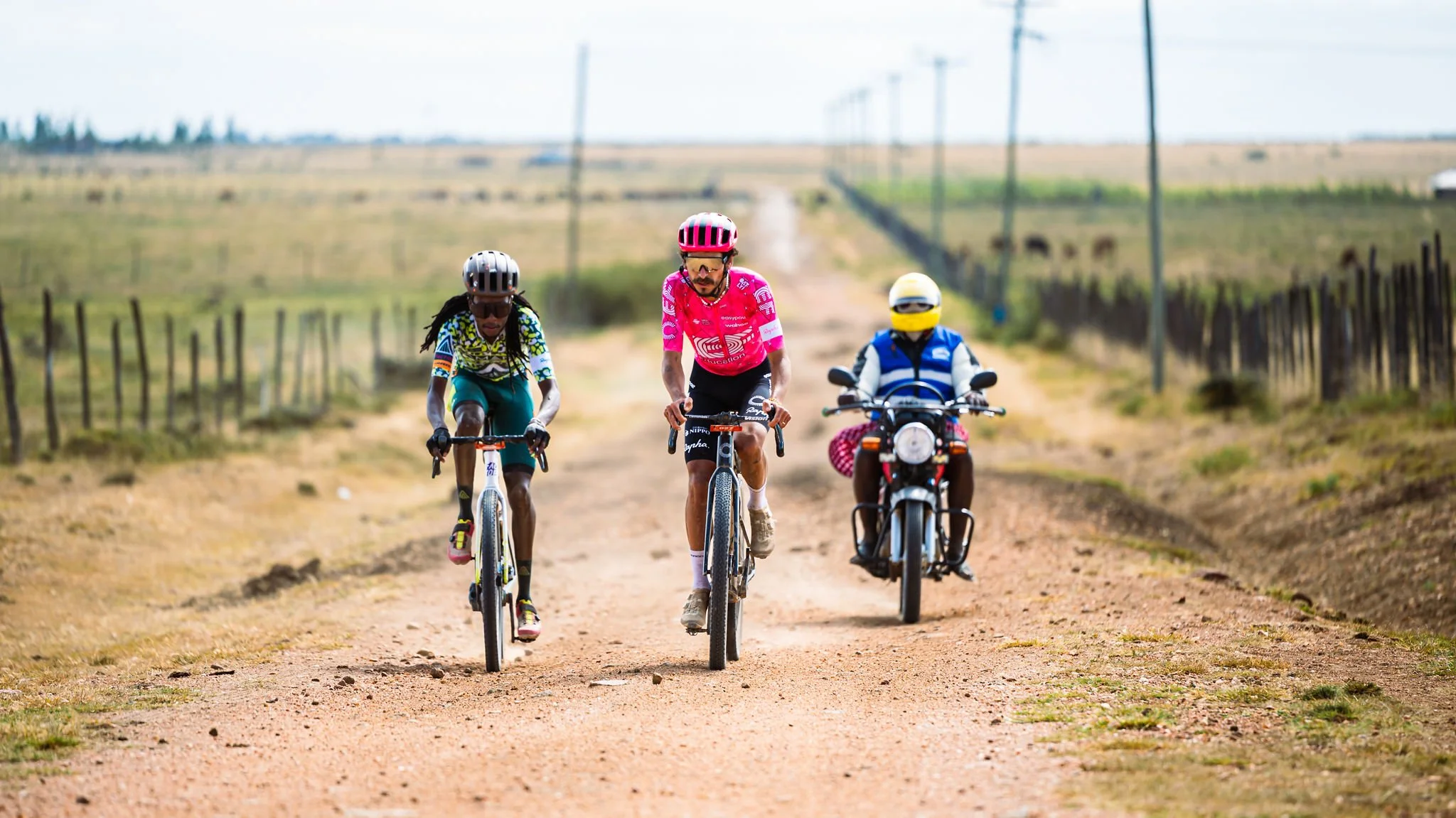
Description: This stage for both routes begins on the vast, flat plains, with 600 meters of climbing. Riders will weave through fences and follow cattle and wildlife tracks as they navigate through shamba areas. Wildlife sightings are common at the start and finish. As the day progresses, the famed headwinds on the open plains—nicknamed "the Dutch Mountains"—will intensify, especially for those on the longer Wildebeest route. The Zebra riders will take shorter paths but still face key sections of rugged type 4 to 5 gravel. Hydration and endurance are key, especially as the heat and winds pick up in the afternoon.

Stage 2 - Mountain stage
Leopard - 144km, 1690m climbing
Zebra - 111km, 970m climbing
Description: Formerly known as the Queen’s Stage, this 144 km route includes 1690 meters of climbing, challenging riders both physically and mentally. The new route features a longer approach to the iconic Mlima wa Shetani climb, skipping the detour to the Tanzanian border and returning directly to the wild camp. The stage begins with a flat section to warm up, followed by the tough climb up Mlima wa Shetani. Riders will then tackle the technical Lachy’s Delight single-track descent before navigating the winding trails of the Savage Garden in Loita Forest.
After exiting the forest, the route leads back to camp, passing through wildlife areas and Maasai villages, with the possibility of encountering elephants along the way. The final 70 km is a mix of climbs and technical descents, making hydration, nutrition, and preparation essential. The stage is a true endurance test, with unpredictable weather and difficult terrain, including thick black clay when it rains.

Stage 3: Queen Stage: Wide Savannah and Fast Gravel
Leopard - 158km, 2490m climbing
Zebra - 132km, 1880m climbing
Description: Stage 3 of the Migration Gravel Race covers 158 km with 2500 meters of climbing, offering a faster-paced ride compared to Stage 2. This section provides a smoother course, starting with hard-packed black gravel across vast open savannah, allowing riders to pick up speed. The route takes riders through wildlife-rich plains, where encounters with wildebeest, zebras, and gazelles are common. However, caution is required at bridge crossings, which are often at the base of fast descents and may have hidden dips or holes.
Despite the faster pace, the 1600 meters of climbing, especially in the afternoon heat, will still challenge riders. The wide-open terrain offers little shelter, making hydration and focus essential to completing the stage. Though a break from the more technical sections, this stage remains a demanding test.

Stage 4: The Final Push
Leopard - 181km, 1980m climbing
Zebra - 120km, 1260m climbing
Description: Stage 4 of the Migration Gravel Race spans 181 km with 1980 meters of climbing, serving as the grand finale of the race. Riders begin by tackling one last climb in the Loita Hills before descending toward the Mara plains. The stage features a mix of hard climbs and fast, flowing descents, testing both endurance and skill.
After the descent, riders cross the open plains, experiencing the savannah one final time before returning to the wild camp. With constant wildlife encounters and stunning scenery, this stage provides a fitting end to the race. Though less intense than earlier stages, the heat of the Mara and the distance will still challenge riders, requiring strong focus, stamina, hydration, and pacing to finish strong.
Mandatory Equipment
GPS Mapping Device (we recommend non-touch screens like the Wahoo Roam)
Tracking/timing device (to be provided as rental from MGR organization)
Capacity to carry 3 liters of water. Feel free to use extra bottle cages and/or camelbacks (temperatures can reach up to 30+ degrees Celsius).
Mobile phone with local SIM card or roaming capacity (there is 3G coverage for most of the race)
Helmet and gloves (gloves are really necessary)
Bike repair tools and spares (you are responsible for your own maintenance on the road)
Travel insurance
Waterproof rain jacket
Basic emergency kit with band-aids, paracetamol, gauze, etc.
Sleeping bag
Lion spray (joking)